
I got married in May 2020. Fortunately, it was a court marriage because of COVID-19 restrictions. “Fortunately” because when I got engaged I realized how torturous Indian rituals can be. Wearing a huge costume with 1–2kgs of make-up, stupid photoshoots, standing on the stage for four hours without food, a bursting bladder, and a super fake smile.
So, after the engagement ceremony, I decided that I would get married in the court without any sho-sha. But, to convince my parents and loved ones of this idea was the most challenging part for me. The things that I wasn’t comfortable with marrying through Indian rituals were:
1. Kanyadaan
The term literally translates to giving away one’s daughter. The bride’s father takes her hand and offers it to the groom, symbolically giving her away. Well, I am not some object that my father can give away. Moreover, I didn’t want to be given away. My parents have two daughters and I am the elder one; somewhere I feel responsible for taking care of my parents and always being there for them.
When I shared this point, my parents said, “It is just a ritual. It can’t take you away from us. You will always be our daughter no matter what.” Well, why follow such rituals that you don’t believe in and just do them for the sake of society?
2. Bidaai
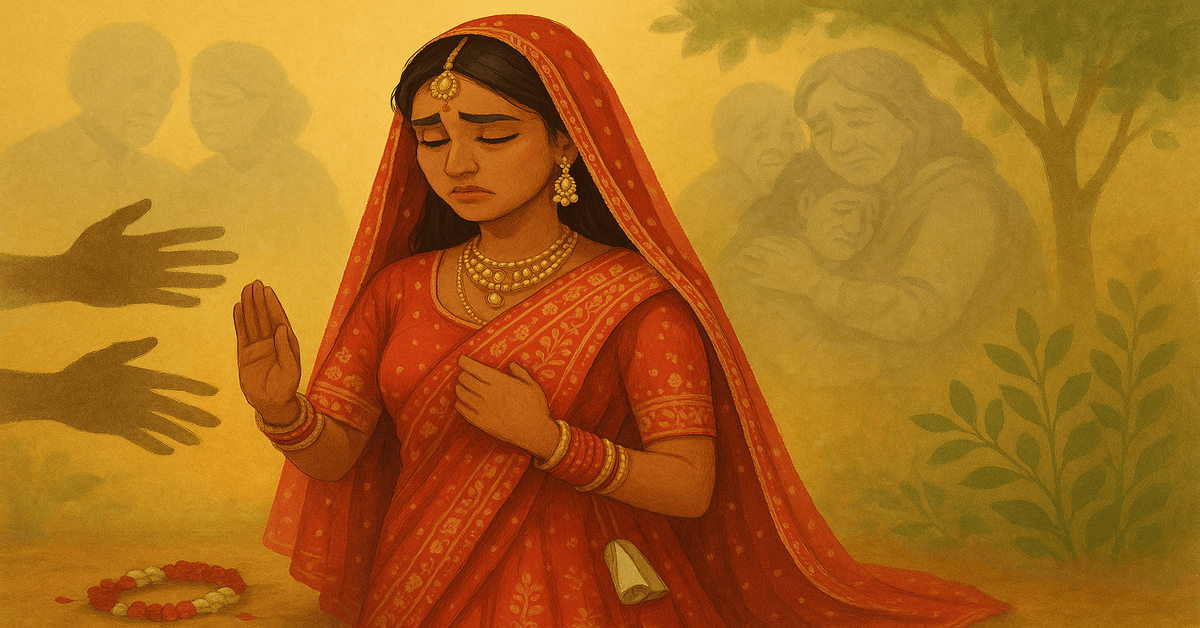
‘Bidaai’ means farewell. In this ritual, the family of the bride officially bids farewell to their daughter as she leaves for her husband’s home. Since childhood, I had heard from different people that the place where I was living was not my permanent home and my real home was my husband’s home. Things like “Paraya Dhan”, “What will your in-laws say about our upbringing?” and “You’re going to go to a different house,” sound super strange to a small girl who is enjoying life and just concerned about how to win the cycling race with her friends! I never wanted to be sent anywhere. I had seen in Indian marriages how the family would cry hugging the bride. Well, I didn’t want anyone to cry on the occasion when I decided to spend my entire life with the man I loved.
To this point, my parents said, “Okay, we won’t cry. We will laugh at the end of the marriage. You go to your husband’s place and come back in an hour.” Well, it didn’t make any sense to me.
3. The girl needs to stay at the guy’s place
Now, this was a ritual in the old times because, in those times, men were the breadwinners and the women were homemakers. But, this ritual makes no sense in today’s world. If my husband can stay at his place after getting married, why can’t I? So, when I decided to in the house where I grew up, people would look at me as if I was committing a crime.
My parents said, “Every woman in our house is staying at her husband’s place. Who are you? Why do you want to change these things? The ecosystem of the society will collapse if every woman refuses to leave her house.”
Well, if society ensures that every woman is allowed to follow her heart we can achieve an ecosystem where women are less stressed, more creative, and focused on things that help them grow.
Today, I am so happy and content that I took a stand for myself and my beliefs. I am glad that I fought this battle all alone and eventually, became a stronger and more mature version of myself.
But does this mean every woman should follow the same path? Absolutely not! Women should do whatever they feel is right. If their heart is dancing by following the rituals, amazing. But if their heart is sinking upon the thought of leaving their house, then they should speak up! Indian society is amazing and very empathetic. It evolved from rituals like Sati, Jauhar, Devadasi, and more. But only when women started speaking up. So let us all speak up for our happiness!
 khushboomehta.co.in