
“We will sightsee until 4, chill for 2 hours, and at 6 go to the sunset point,” said my sister as she made a list of places we had to visit in Rishikesh.
Everything was going as per the plan. But in the rush to see everything we skipped our lunch.
So before heading to the sunset point, we stopped to have our first meal of the day. We were so hungry that we ordered too much food and struggled to finish it.
Anyway, we stuffed our stomachs and headed to the sunset point!
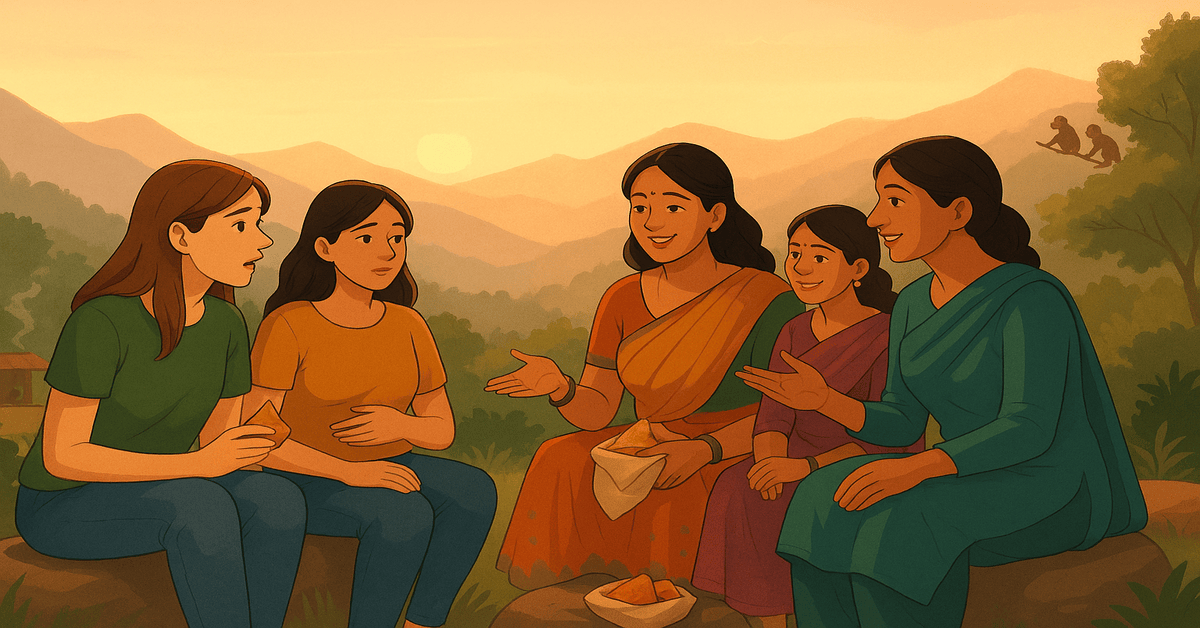
The view at the top was amazing. In a corner, was a small chai tapri. Down in the valley, were monkeys playing. And, on the edge were three women cutting wood.
The women’s laughter echoed in the mountains, I told my sister, “Let us talk to these women, they look interesting.”
My sister, who has a talent for talking to strangers, directly approached the women and said, “My sister wants to feed these monkeys can you please make her understand how dangerous these monkeys can be.”
Instantly, the women started elaborating on the wrath of monkeys — how they attack humans, ruin the crops, barge into kitchens, and whatnot.
After that, we talked about random things like from where we belonged, who was in our family, the weather, and so on.
In just 10 minutes, we all felt so connected to each other, that one of the women removed hot samosas from a bag and offered them to us.
My sister and I said, “Thanks but we just had so much food. Can’t eat anything more.”
Just then one of the women said, “We are Rawats, you can eat from our hands. We are not from the lower caste.”
What! It took me a while to process that. I didn’t know what to say, but I understood that the women were thinking that we were not eating the samosas because we thought that the women were from a lower caste.
I just grabbed the two samosas and started eating them. With every bite, I just kept thinking about how people can misinterpret our actions and relate them to something that didn’t even cross our minds.
I finished the samosas and told the woman, “It’s not about the caste. We were just so full that we couldn’t eat anything.” They smiled and after a small conversation, we parted ways.
But this incident has stayed with me to this day. I really can’t forget the awkwardness of those 3–4 minutes when the women thought that we refused to eat the samosas because of their caste.
What made them think like that? Did someone reject their food because of their caste? Why did they mention their caste in front of the strangers?
I don’t know what the reason was. I just know that they were the most welcoming, beautiful, and friendly women who misunderstood my actions.
It hurts me that even today, some people are still focused on caste, religion, where we are from, and the language we speak. I am not saying these things don’t matter — they do! They help us feel like we belong somewhere in this vast universe.
But when we forget that we are all humans first, we lose the chance to create something special. By seeing each other as people before anything else, we can form magical connections and at the same time enjoy our differences.
If you like my story, support me by buying my dog and cat some food.
 khushboomehta.co.in