
My grandmother-or Aai, as I called her—was a 12th-pass woman who lived in the city and got married to a farmer in the village. For many years, she lived in the village, so even after being educated, Aai started thinking like a typical village woman.
When my younger sister was born, Aai wrote a letter to my mother showing her disappointment for giving birth to a second girl. She would discriminate a lot between girls and boys.
I strongly remember one incident from my childhood.
Two of my cousin sisters had crocheted a beautiful door hanging. Aai praised them and kissed them on their forehead. I had seen her praise our cousin brother many times, but rarely the girls. I thought if I made something, she would praise me too.
So I took a plastic bag, picked up a needle, some thread, and stitched the words: “I love you, Aai.” It looked shabby and imperfect, but it had my love.
I gifted it to Aai. She just smiled — no words, no appreciation. But I was too young to feel bad.
The next day, my aunt was sweeping the house and brought a pile of swept waste into the room where we kids were playing. In that pile, I saw my stitched plastic bag.
I picked it up, dusted it off, and asked, “Who threw this? I had gifted it to Aai.”
My aunt said, “It was already lying on the floor.”
That’s when I felt bad. I let the bag go into the dustbin. From that moment on, a part of me believed Aai didn’t love me.
Years later, during my engineering days, I went to the village to stay with Aai and Daddu, my grandfather.
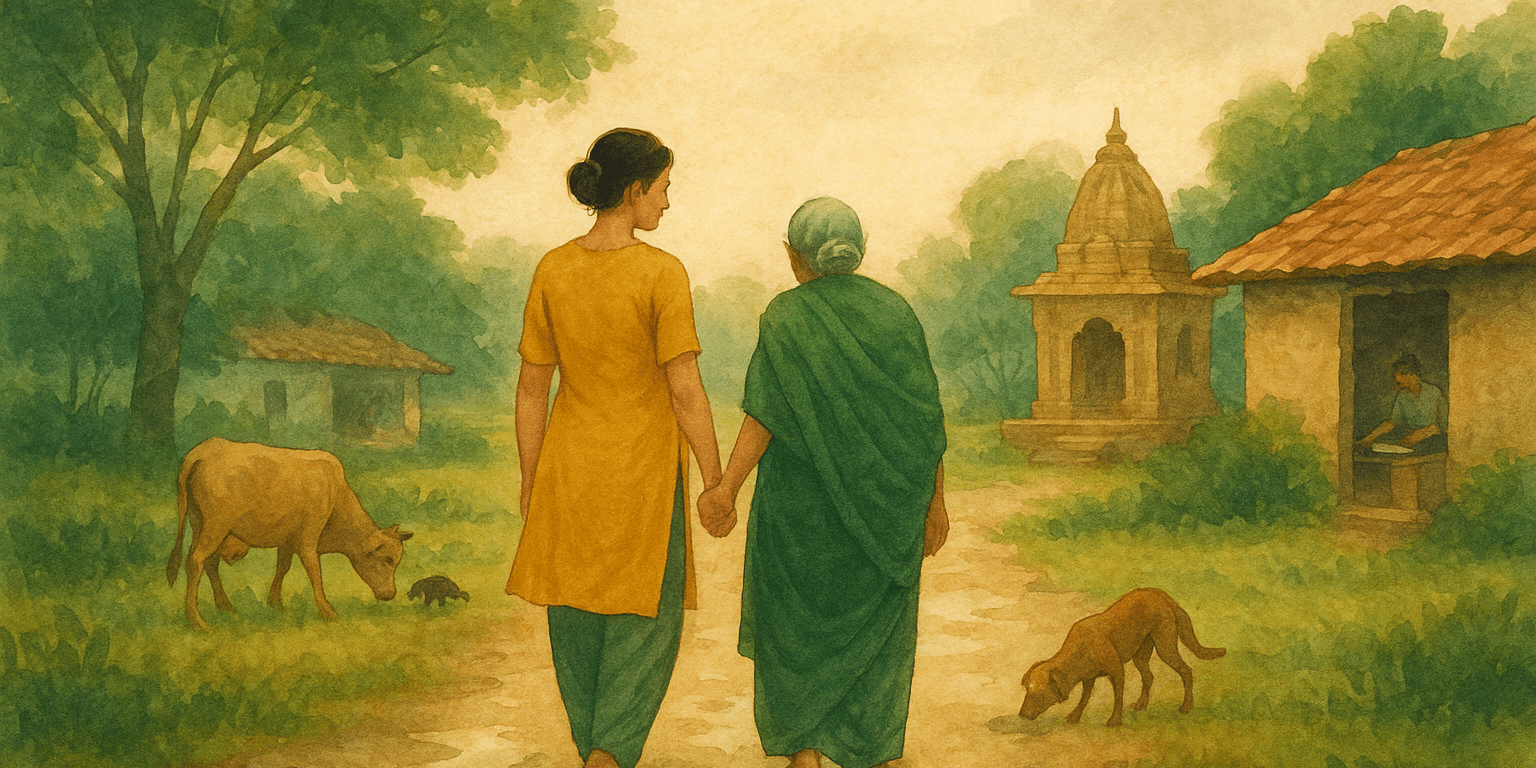
In that one week, every morning, Aai would give me a glass of fresh milk. After breakfast, we’d walk hand-in-hand to a nearby temple. On the way back, we’d feed rotis to cows and dogs.
In the afternoons, Aai would cut vegetables, I’d cook the sabji, and Daddu would make the rotis. In the village, it is a taboo for men to make rotis, but because Aai hated making them so Daddu would do it happily.
In the evenings, Daddu would take me on a bike ride to a nearby town to eat pani puri, buy groceries, and sometimes parcel dinner for Aai.
After returning home, some relatives would come over, I would make chai for them, and finally, we would call it a day with a walk in our farms.
That was our daily rhythm — and honestly, it was one of the happiest times of my life.
When I returned from the village, my mother told me, “Aai was praising you a lot. She said you’ve become very mature, and you helped her a lot. She’s proud of you.”
So many years had passed since the plastic bag incident. But in that moment, I realized my heart had been waiting for Aai’s appreciation all along.
Today marks one month since Aai passed away.
When I first saw her in the hospital, I felt confused. I remembered all the hurt, the discrimination, the way she treated me, my sister, and other women in the family.
I didn’t feel sad because I couldn’t connect to her pain.
But when she died and her body was taken away, I broke down. Suddenly, it hit me: I was never going to see her again.
Through her passing, I’ve learned something important: Our loved ones will give us good and bad memories. But it is up to us what we want to remember.
Today, as I write this blog, I want to remember only the village memories that I created with Aai, nothing else.
I know she wasn’t perfect. None of us are. But somewhere beneath her complaints, comparisons, and expectations, there was a woman who longed to be seen, valued, and loved.
Maybe she was never truly loved for being a woman; that’s why she struggled to love other women.
But I choose to believe she did the best she could. And, that’s what we’re all doing — trying to love and be loved, in the only way we know how.
 khushboomehta.co.in