
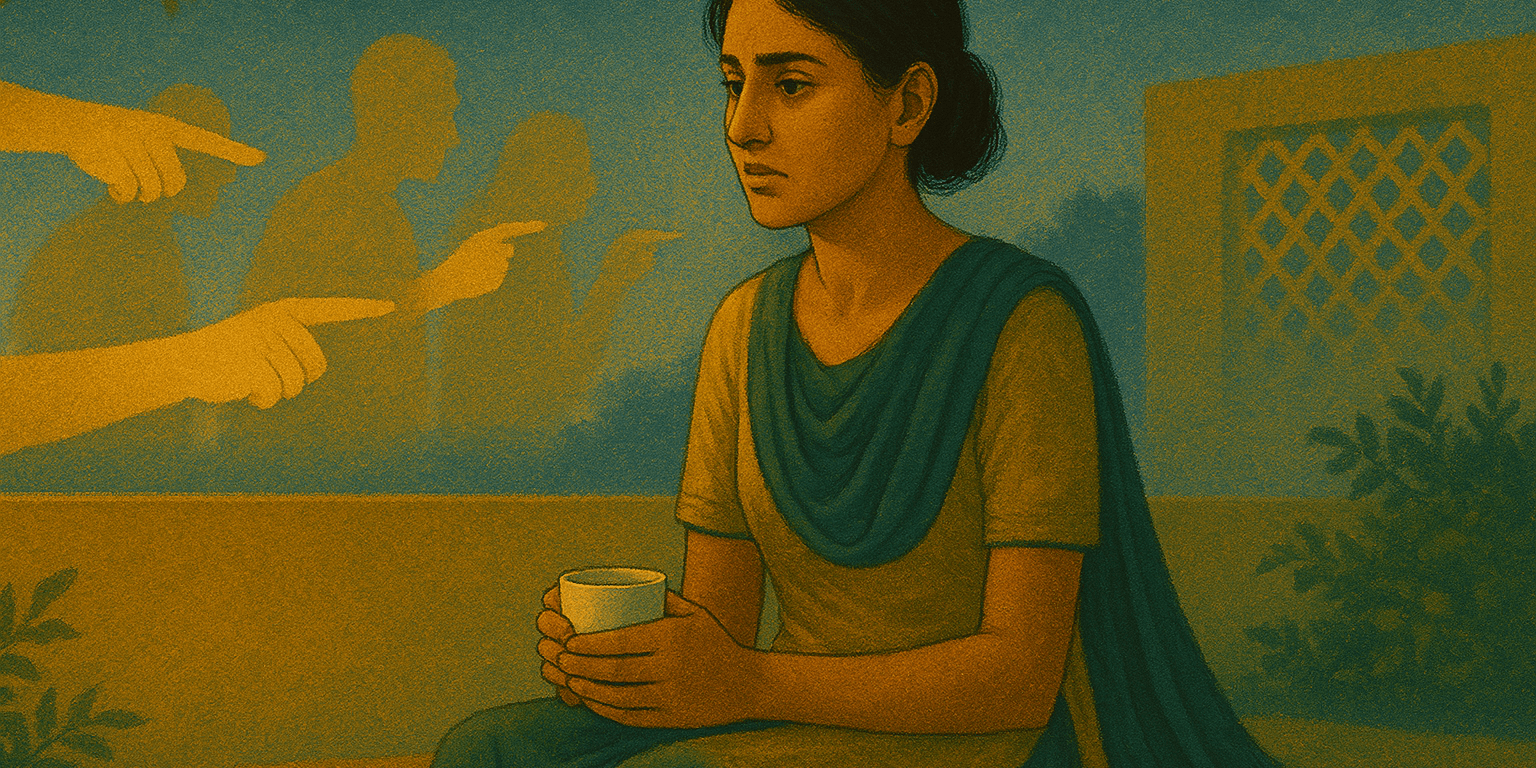
In India, when a woman gets married, she leaves her parents’ house and starts living at her husband’s house. But when I got married, I refused to move to my husband’s place. I thought this ritual didn’t make any sense in modern times.
My relatives, however, didn’t like this. They questioned my parents, “Why is she still staying with you and not adjusting? Is there something wrong?” My parents would often feel embarrassed and divert the conversation.
But personally, I never felt I was doing anything wrong.
Just imagine there is a man who is into drugs, gambling, and all kinds of self-destructive behavior. The relatives look at him and say, “What a useless chap. A liability for his parents, they must be suffering so much.”
Versus, there is a girl. She studies hard, earns well, and treats everyone with respect. She doesn’t want to quit her job, wants to live separately from her in-laws, and chooses to be child-free. The relatives say, “What kind of upbringing is this?” “She has no values. No shame.”
What changed in both scenarios?
Just the gender, right?
When a man does wrong, the blame is his, and when a woman refuses to please everyone, the blame is her parents’.
I have been living away from my parents for ten years now. Even if my parents raised me with the best values — and they did — what I am today is shaped by my environment, my experiences, the people I meet, the content I consume, and the life I’ve built.
So when I don’t please people, my parents aren’t answerable for it.
Since childhood, we women have been told that the honor of the entire family rests on our shoulders. From choosing the career options, making friends, what we wear, to the man we marry, at every step we have to think about the family before ourselves.
But when I step back and look closely, I realize that this pressure has been passed down for generations.
My grandmother is always trying to please everyone in the family. She cooks, cleans, remembers everyone’s preferences, sacrifices her time — and yet, even after doing everything right, she is never appreciated. She exists quietly in the background, as if being good is her duty, not her identity.
My mother, on the other hand, is different. She lives more freely and makes her own choices. But now, as she grows older and becomes more connected to the community, I see her trying to fit societal expectations.
Then there’s me. Even though I’ve rebelled against many things — jobs I didn’t want, rituals I didn’t believe in, opinions I didn’t agree with — there are hundreds of things I’ve quietly sacrificed to protect my parents.
Most days, I am so overwhelmed by the pressure to be good that it feels like I have no space left to be human.
Honestly, being “good” for society means being silent, obedient, and invisible. And I no longer want to disappear to make others comfortable.
So to every woman who’s ever been made to feel guilty for simply choosing herself — and to every parent who raised a daughter with courage but was made to feel ashamed — you did not fail.
The society did.
And maybe the real rebellion isn’t in shouting or fighting — Maybe it’s in simply living as if we don’t owe anyone an explanation for who we are.
Lastly, the most radical thing a woman can do in today’s world
is to be good on her terms — and still look society in the eye and say,
“This is me. And I’m not sorry.”
 khushboomehta.co.in